Anne Boleyn is famously seen as the reason for Henry VIII breaking from the Catholic church. Her interest in at least reforming religion in England, if not going more toward the way of Martin Luther, made her a figurehead in some ways for underground efforts. In reality, Henry was finishing the work of his forbears from centuries before. He also quickly learned that he needed to pull away from Rome so that he could have full control of legal matters within his kingdom, without outside meddling or dawdling,
“Although Henry had grown frustrated over the confounding dithering of Clement VII and ineptitude of Cardinal Thomas Wolsey in the handling of his Great Matter, the issue of Henry VIII’s annulment from Katharine of Aragon was not the biggest problem. The biggest problem was, Henry rapidly learned, that he had no control over his legal system in very important arenas when he needed it most. Aside from not having legal control, the lag time in communications being sent from London to Rome and back again contributed to the delay in Henry’s annulment proceedings, too.
Once Henry was set on his path inspired by Anne Boleyn, he learned just how much money was being kept out his coffers. Cardinal Wolsey started the process before his death, but Thomas Cromwell and Anne spurred Henry to continue shutting down religious institutions in an effort to redistribute the nation’s wealth in favour of crown and kingdom. None of these ideas were novel….
Loosening the church’s powers with England began at the very tail end of the High Middle Ages with Edward I of England. At the beginning of the thirteenth century with the enaction of Magna Carta, the passing of land to a corporation, like a church, without royal consent was forbidden. …Edward I enacted the Statutum de Viris Religiosis, or Statute of Religious Men, in 1279…It forbade the passage of any lands in mortmain [meaning “deadhand”] to any religious man. If anyone did pass their lands to a religious man, then those lands were forfeited…The goals of the Mortmain statutes were not achieved until Henry VIII’s Parliament passed several statutes in 1529 and one directly addressing mortmain in 1531. Henry then began dissolving the monasteries in the 1530s, something he arguably would not have done without being encouraged by his fixation on and love for Anne Boleyn…
Henry VIII was not the first king of England to challenge the pope’s authority. He was the fourth, although the laws of the first two kings were more or less forgotten by the time Henry started taking action. Edward III passed the first, overtly aggressive statutes against papal power, with his successor Richard II taking even stronger action…The laws fell by the wayside during the fifteenth century, not to be fully revived until Henry VIII needed to assert stronger control….
[Edward III] enacted the Statute of PraemunireFacias, or simply the Statute of Praemunire, in 1353. This statute severely curtailed the influence and outright meddling of papal authority and other foreign powers within England… The punishments for the Statute of Praemunire were…severe. Anyone who effectively requested foreign interference with any legal matter, temporal or ecclesiastical, that rightly was under the purview of the king of England’s courts, was at risk of imprisonment, being outlawed and forfeiting all their property, goods, lands, and chattel. These were extremely serious penalties.
Anne Boleyn; (c) National Trust, Petworth House; Supplied by The Public Catalogue Foundation
Being outlawed meant that the person had no rights or legal protection. Effectively, they were stripped of personhood and did not exist. If the person were robbed and killed after being outlawed, no crime was committed because the person existed outside of the law. Being outlawed was a desperate state of living and reserved for only the worst criminals, as in some ways it was a fate worse than death. The only positive element of being outlawed was that a person, if they survived their term of outlawry, they could be allowed back into society. Once recognised as a legal person again, they were usually at a diminished station, but at least they were alive and had rights… [Updates] were made to the Statute of Praemunire in 1365, curtailing the ability of the papal court to act as a court of first impression or a court of appeal for matters arising in England…
Roughly twenty-five years later, Richard II continued his grandfather Edward III’s work… The 1393 Statute of Praemunire Facias, enhancing the law passed in 1353, did not allow the papal curia to hear any non-spiritual matters that were prejudicial to the king, or went against the customs and laws of England. Spiritual matters could still be heard in Rome, such as divorces and annulments. Anyone who violated the 1393 statute risked punishment by forfeiting all that they owned and being outlawed. The same punishment applied to anyone who aided and abetted them. This was where Henry VIII suffered from the decisions of his great-great-great-granduncle Richard II in Henry’s Great Matter with Katharine of Aragon. This is why Henry’s annulment proceeding simply had to be heard by the pope in Rome, unless Cardinal Wolsey could figure out a solution.…”
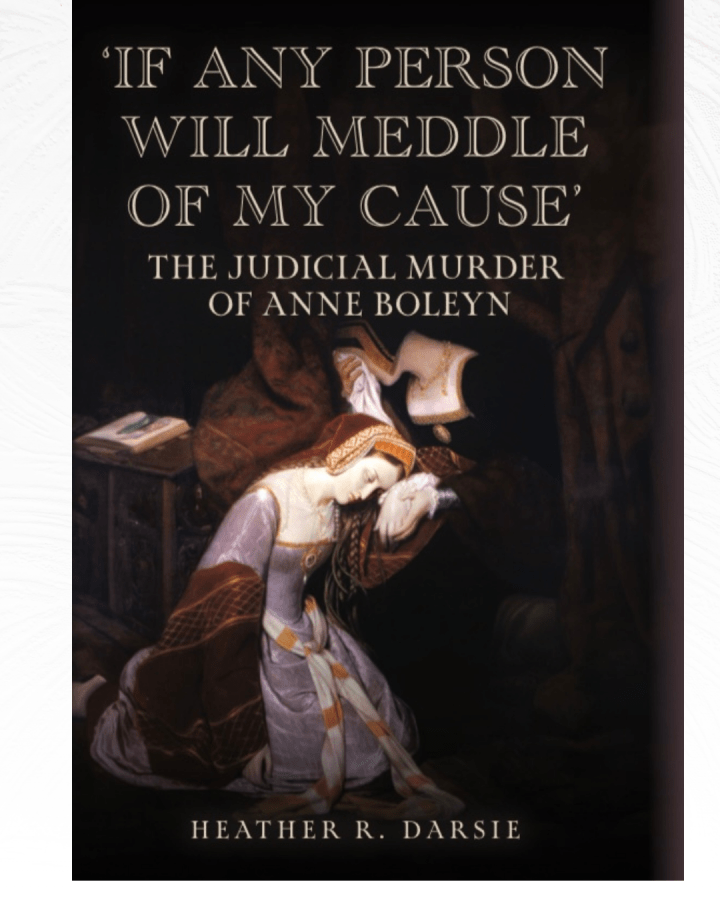
Henry VIII’s need for Anne Boleyn opened his eyes to the restrictions of his legal control within England. Their passion inspired Henry to complete the work that was begun hundreds of years before anyone conjured the name of ‘Anne Boleyn’. For more, pick up a copy of If Any Person Will Meddle of My Cause: The Judicial Murder of Anne Boleyn, available via hardback and Kindle in the UK, or via Kindle internationally. Hardbacks are available for international pre-order, with release on 21 April 2026.



 Maidens and Manuscripts: Taking a fresh look at people and events from 1347 to 1625, with a focus on women and illuminated manuscripts