Anne Boleyn and Henry VIII: The Last Love Letter

by Heather R. Darsie Henry VIII of England’s last love letter to Anne Boleyn shows how close and far the couple felt to achieving their purpose of an annulment for Henry from Katharine of Aragon, which would pave the way for Anne to marry Henry. Henry is also chiding Anne just a bit, referencing her “inutile and vain” thoughts, or baseless flights of fancy. He … Continue reading Anne Boleyn and Henry VIII: The Last Love Letter

The Armada is Coming!

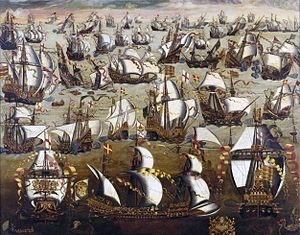
by Heather R. Darsie Please note that this post originally appeared on TudorsDynasty.com. It was 29 June 1588. The Spanish Armada sailing in its customary crescent shape was spotted off the coast of Cornwall. After many years of waiting, the time had finally come: Spain was invading England to reclaim the country for Catholicism.  It is possible that Philip II, former brother-in-law to Elizabeth I previous … Continue reading The Armada is Coming!

A Brief Look at Jousting Armor

by Heather R. Darsie Jousting, much like Rugby or American Football, was a full-contact, dangerous sport. Severe injuries and even death were quite common. Henry II of France died in 1559 when a lance’s splinter breached Henry’s helmet and entered his brain by way of the eye.  More like American Football and less like Rugby, individuals participating in the joust wore protection. Turnierbuch Ritterspiele Most … Continue reading A Brief Look at Jousting Armor

Love Letter Sixteen from Henry VIII to Anne Boleyn

by Heather R. Darsie The sixteenth love letter from Henry VIII to Anne Boleyn was written around the middle of September 1528. Pope Clement VII, captured by the Holy Roman Emperor Charles V in June 1527 after the sacking of Rome in May, was still Charles V’s prisoner. The Pope did not return to Rome until October 1528. When Henry wrote this letter, he was … Continue reading Love Letter Sixteen from Henry VIII to Anne Boleyn

The Revenge of Margaret Pole

by Heather R. Darsie In case you missed it on QueenAnneBoleyn.com On 28 July 1540, a great, accomplished man of Tudor Times was beheaded on Tower Hill. That man was Thomas Cromwell, briefly the 1st Earl of Essex, and Henry VIII’s Chief Minister. Cromwell sought to reform and consolidate the legal system the secular legal system and move away from canon law. Cromwell succeeded in establishing … Continue reading The Revenge of Margaret Pole

The End of Kett’s Rebellion

by Heather R. Darsie July, 1549. The almost twelve-years-old Edward VI had been King of England for two-and-a-half years. Landlords had begun enclosing the common lands, which prevented peasants from being able to have a place for their animals to graze. Several landlords had taken to raising sheep, as the English wool trade was growing quite prosperous. This, in concert with a host of other … Continue reading The End of Kett’s Rebellion

The Scots Queen Surrenders: An Overview of the Battle of Carberry Hill

by Heather R. Darsie By 15 June 1567, twenty-four-year-old Mary Stuart had been Queen of Scotland for almost her entire life; never knew her father, James V, because he died when she was six days old; was Queen Consort, then Queen, of France for less than seventeen months; had lost her mother in July 1560; was about to celebrate her son and heir’s first birthday … Continue reading The Scots Queen Surrenders: An Overview of the Battle of Carberry Hill

Love Letter Twelve from Henry VIII to Anne Boleyn

by Heather R. Darsie The twelfth love letter from Henry VIII to Anne Boleyn is a doozy, colloquially speaking. It shows the passion Henry has for Anne, the court intrigues of the Boleyn family, issues Henry had with religious entities in England, and was likely written just before Cardinal Wolsey made a brazen move counter to Henry’s wishes. Let us begin.  Wenceslaus Hollar, via Wikimedia … Continue reading Love Letter Twelve from Henry VIII to Anne Boleyn

Sorrow in the City: Reactions to the End of an Age

by Heather R. Darsie, J. D.  On 24 March 1603, Elizabeth I died. She was approaching the age of 70 years. “It is not my desire to live or to reign longer than my life and my reign shall be for your good,” said Elizabeth to her parliament in 1601. Upon one of the many times parliament questioned Elizabeth about her plan of succession, she … Continue reading Sorrow in the City: Reactions to the End of an Age