
with Heather R. Darsie, J. D.
I am delighted to host my friend Susan Abernethy during her blog tour for Charles II’s Portuguese Queen: The Legacy of Catherine of Braganza. Please enjoy this post by Susan, below.

England and Portugal had a long-standing relationship. The two countries brokered a diplomatic and commercial treaty as early as 1386, establishing a pact of mutual friendship and support. This treaty is still in force to this day.
Of significance during the time of negotiations for Charles II and Catherine’s marriage, in 1640 and in 1660, a restoration of two monarchies occurred, one in Portugal and one in Britain. Portugal, after many years fighting off the specter of Spanish rule, came under the sway of Spain when King Philip II invaded and took over the country in 1580 following a succession crisis. At first, this worked positively for Portugal but eventually, Spanish rule became onerous, and the people rebelled.
Catherine’s father, the wealthiest and most powerful duke in Portugal at the time, had a claim to the Portuguese throne. During Catherine’s second birthday party, attended by many of the Braganza’s supporters, they attempted to persuade the duke to take the throne if they successfully expelled the Spanish. At first, the duke was reticent.
But his wife, the indomitable Luisa Maria Francisca de Guzman, daughter of a Spanish nobleman, convinced her husband to follow through with the request. In December 1640, after a nearly bloodless coup, the Spanish withdrew, and the duke ascended the throne as King John IV. Catherine’s family moved from their country estate of Vila Viçosa, just west of Lisbon, to the Ribeira Palace on the river Tagus in the capital.
The Spanish were not happy with this state of affairs and the War of the Portuguese Restoration began and it would last until 1668. This led the Portuguese monarchy to look to other European countries for aid. King Charles I of England was the first European government to recognize the Braganza monarchy and discussions for a marriage of the Prince of Wales to a Portuguese Infanta ensued. Following the civil wars in England, the Stuart dynasty fell when King Charles I was executed in 1649, sending his two eldest sons, his wife and his youngest daughter into exile and suspending the Portuguese marriage discussions.
For the next ten years, King Charles II was in exile on the Continent while the Protectorate and the Commonwealth, under Olliver Cromwell, took over the governance of England. This regime ended following the death of Oliver and the weak rule of his son Richard, and the English Parliament asked Charles to return to the throne. Around the same time, in 1659, after many years of an alliance between Portugal and France, France decided to make peace with Spain, leaving Portugal on her own.
Finding a wife was one of the first items on King Charles II’s agenda. Catherine’s mother, who acted as regent for her brother King Afonso, needed English aid and troops following the abandonment of the alliance with France. Queen Luisa offered her daughter Catherine as a wife for Charles, along with huge cash dowry and the ports of Tangier and Bombay, among other considerations. The cash definitely intrigued the broke King Charles, and he decided to pursue the Portuguese marriage. On June 23, 1661, after months of negotiations, a marriage treaty agreeing to the union of King Charles II of England and Catherine of Braganza was finalized.
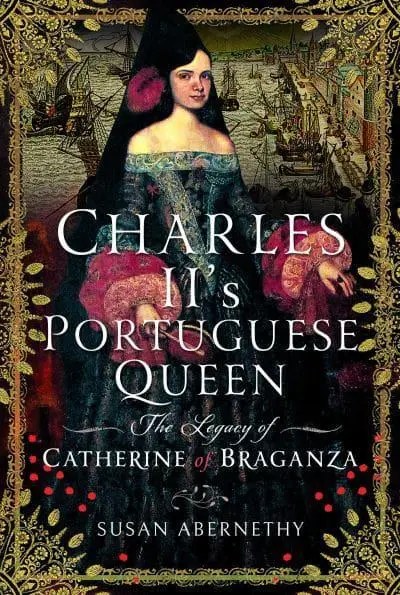
To find out more about Catherine of Braganza’s story, read Charles II’s Portuguese Queen: The Legacy of Catherine of Braganza, now available from your favorite bookseller.
Susan’s passion for history dates back fifty years and led her to study for a Bachelor of Arts degree in history at the University of North Carolina at Charlotte. She is currently a member of several historical and writer’s associations and her work has appeared on numerous historical websites and in magazines and includes guest appearances on historical podcasts. Her blog, The Freelance History Writer, has continuously published over five hundred historical articles since 2012, with an emphasis on European, Tudor, Medieval, Renaissance, Early Modern and women’s history. She is currently working on her third non-fiction book.
If you’d like a general overview of the Stuart Dynasty and their husbands and wives, you might enjoy my book Stuart Spouses: A Compendium of Consorts from James I of Scotland to Queen Anne of Great Britain.

 Maidens and Manuscripts: Taking a fresh look at people and events from 1347 to 1625, with a focus on women and illuminated manuscripts