

by Heather R. Darsie, J. D.
The current Salisbury Cathedral was constructed at a quick clip from 1220 to 1258. An impressive number of stone masons carved and formed the bricks, finials, and columns from three types of limestone. They filled in the spaces between the cathedral’s Early English Gothic vaulted arches with tufa. The building dominated the building when it was built, but needing more glory for God, the impressively tall spire was added in 1320. Ever since the dilapidated spire on the old St. Paul’s Cathedral in London fell in 1561, Salisbury Cathedral’s spire has been the tallest medieval spire in England.
Before continuing on to the main discussion, it is important to be aware of the history of Old Sarum, the original site for the first and second cathedrals at Salisbury. About 3 miles or 4.5 kilometers slightly northeast of the new cathedral is found Old Sarum, the original neolithic hill fort. The hill fort was in turn occupied by Iron Age, Celtic, Roman and Anglo Saxon peoples. Unfortunately, there are virtually no records of the site during these periods, but what evidence does exist seems to support the longevity of the site. The first cathedral was built in the large outer/lower bailey in the late eleventh century. A grander cathedral was built there in the 12th century, then the entire site of the cathedral was abandoned by the early 13th century when construction of the current cathedral was sufficiently completed.
When William the Conqueror (r. 1066 — 1087) arrived in the late 12th century, the Old Sarum hill fort skyrocketed in importance for the royal family. He ordered that a castle and accompanying palace be built there, the remains of which can be visited today. A motte was created on the flat hilltop, creating the current topographical shape. Before, Old Sarum was completely flat and surrounded by its ditch. With William’s orders, a second ditch was excavated and a motte placed in the center. This created the inner/upper bailey, which held the castle, palace, chapels, and administrative buildings. People continued living and working in the outer/lower bailey, where the old cathedral was rather new at the time.
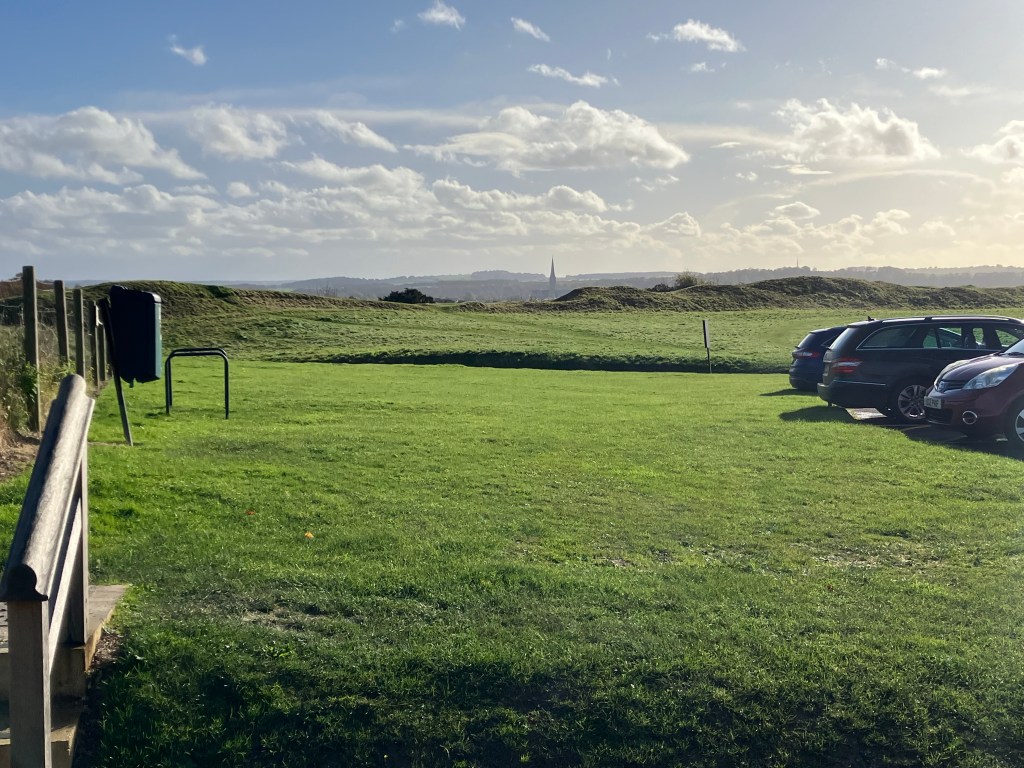
Old Sarum Castle was expanded by Henry I’s regent, who was Bishop of Sarum at the time when the king was out of the country. Improvements included improving the walls around the motte’s top and strengthening the gatehouse. Henry II made use of Old Sarum Castle by imprisoning Eleanor of Aquitaine (b. 1122 — d. 1204) there. After the construction of the new cathedral started in the 13th century, Old Sarum was slowly abandoned. By the time of Henry VIII (r. 1509 — 1547), the castle and its buildings in the inner/upper bailey were in ruins. Henry gave it to a favorite servant in 1514, who reused the materials for other buildings.
Salisbury Cathedral, down in the valley, was one of the nineteen cathedrals in England on the eve of Henry’s Reformation. Of the nineteen cathedrals, Salisbury was one of nine secular cathedrals, meaning it lacked a monastery. According to the Valor Ecclesiasticus compiled for Henry VIII in 1536, Salisbury received around £2,500, or £1.7 million today, per year. Like the other cathedrals, Salisbury had a long-established musical tradition, library, and collection of religious art. As the Reformation pounced into England, Salisbury and the did not much notice what was happening to the monasteries. However, in 1538, pilgrimages and shrines were heavily discouraged, if not quite outlawed. Salisbury, which housed St. Osmond’s shrine, noticed a drop in pilgrims.
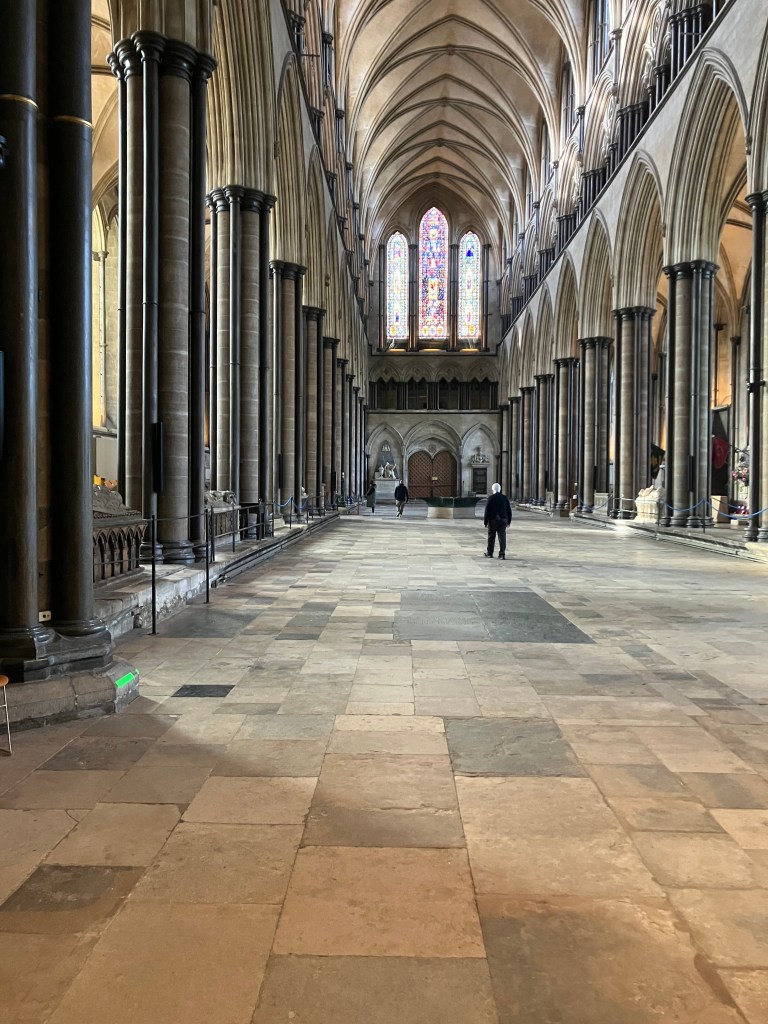
St. Osmund was originally from Normandy and came over with William the Conqueror. He was made Bishop of Salisbury, a position he held for a handful of years before his death in 1070. He was canonized in 1457. St. Osmond’s tomb is still within Salisbury Cathedral, with holes carved into the outer shell. The holes are called foramina It was believed by pilgrims that touching his tomb would relieve them of ailment, and the foramina made it so that pilgrims would be closer to touching his actual body.
Iconoclasm began sweeping through England, causing damage to images and statuary within the cathedrals. The damage did not escape Sailsbury, which saw the shrine of St. Osmond torn down. Interestingly, it is unclear how heavily the cathedral was damaged as a result of iconoclasm versus the cathedral simply falling into disrepair. From restored ceiling paintings, the decorations within the church seemed slightly less ostentatious by the time of the Reformation. The exterior of the church was covered in statues that stood within their designated alcoves, plenty of which are now empty. It is reasonable to assume that the ones lowest to the ground, and ones within Salisbury Cathedral, were defaced or destroyed at some point in the cathedral’s history. The medieval stained glass is completely gone, although it’s anyone’s guess as to whether that was because of the Reformation under Henry VIII, the Protestantism introduced by Edward VI (r. 1547 — 1553), the English Civil War and subsequent Protectorate, or actions of James Wyatt in the late 18th to early 19th century.

The biggest loss to Salisbury Cathedral was the loss of its staff and clergy members during the reigns of Edward VI and Elizabeth I (r. 1558 — 1603). Because of the changes instituted by Edward VI and updated by Elizabeth I, fewer persons were required to care for treasure that was no longer there. There were other reasons for reducing the number of working people at the cathedral, although that is a topic for another post.
Salisbury Cathedral managed to hide some of its treasures, although, as mentioned above, the more public offerings were ravaged and destroyed. In 1539, a total of twenty-five days were spent carefully dismantling St. Osmond’s shrine. In 1549, Salisbury was ordered to send £751,519, the value of today’s value of the cathedral’s plate, to a nearby mint, presumably to help assuage the Great Debasement. The cathedral retained some of its Catholic liturgical items even into the reign of Elizabeth I, which were then ordered sold. Clergy persons associated with Salisbury Cathedral did their best to buy the items themselves in hopes of keeping them.
In 1559, the spire was struck by lightning. This cracked the spire’s structure, heralding a period in the cathedral’s history where the building was degraded. By 1560, the quality of persons who frequented Salisbury Cathedral and its close (or what Americans might think of as a churchyard) were of terrible character. It was reported that robbers, thieves, and other disreputables frequented the cathedral. A couple of years later, the cathedral had visible damage inside and out from the elements. Enough of the stained glass windows were damaged or gone in the 1560s that the rain regularly entered the building. Poorly behavior of the clergy continued during the 1560s as well, with drunkards, adulterers, gamblers, and other ne’er-do-wells being common amongst their numbers at Salisbury.
Fortunately for the cathedral, unsavory reports about the state of the building and clergy were given to Elizabeth I. Between her and a newly-appointed bishop, the clergy’s behavior was improved. Outreach into the community of Salisbury returned, as did hospitality. The poor once more received aid. As a result, the mayor and other important people from the city resumed attending church at the cathedral. This, in turn, led to improvements being made to the physical building. By the early 17th century, the Salisbury Cathedral was restored.
You might also like: Medical Treatment in the 16th Century, Henry VIII Orders Medicine for Anna of Cleves, Martin Luther, Henry VIII, and the Papacy, Martin Luther and the House of Saxony
If liked this post, consider reading Children of the House of Cleves: Anna and Her Siblings, focuses on the German and English Reformations. You might also like to read my biography on Anna of Cleves, the first researched and written from the German perspective, Anna, Duchess of Cleves: The King’s Beloved Sister. Links below.
Sources & Suggested Reading:
- “The cathedral of Salisbury: From the Reformation to the Restoration,” in A History of the County of Wiltshire: Volume 3, ed. R B Pugh and Elizabeth Crittall (London: Victoria County History, 1956), 183-197. British History Online, accessed November 9, 2023, http://www.british-history.ac.uk/vch/wilts/vol3/pp183-197.
- Lehmberg, Stanford E. “Henry VIII, the Reformation, and the Cathedrals.” Huntington Library Quarterly 49, no. 3 (1986): 261–70. https://doi.org/10.2307/3817124.
- Bank of England Inflation Calculator. https://www.bankofengland.co.uk/monetary-policy/inflation/inflation-calculator Accessed November 10, 2023.
- McNeill, John. Old Sarum. English Heritage Guidebooks. London: English Heritage (2022).
 Maidens and Manuscripts: Taking a fresh look at people and events from 1347 to 1625, with a focus on women and illuminated manuscripts
Professor, do you know how tall Margaret of Parma was? Silly specific question, but would you know? The chronicler Strada doesn’t mention it. Do you know someone who might know?
LikeLike
I don’t know specifically. I haven’t read anything that remarked on her being short or tall for a woman, so I would assume that she was average height. I’m sorry that I don’t know more.
LikeLike
Thank you for an excellent read.
Re- “About 3 miles or 4.5 kilometers slightly northeast of the new cathedral is found Old Sarum, the original neolithic hill fort. The hill fort was in turn occupied by Iron Age, Celtic, Roman and Anglo Saxon peoples. Unfortunately, there are virtually no records of the site during these periods, but what evidence does exist seems to support the longevity of the site. “………
I have in my gift some peculiar evidence I’ve gathered from the lives of the Bishops Poore, ELa Longespee and the Angevin investment in the new town that promises to shed light for you too on the lack of evidence from the earlier than Sarum/ Sarrum times of the 402 a.d. Notitia Dignitatem i.e. in the Roman Period of Late Antiquity; if you are interested I’d be delighted to share it with you.
LikeLike
Sure, why not? You can use the contact form on this website.
LikeLike
LikeLike